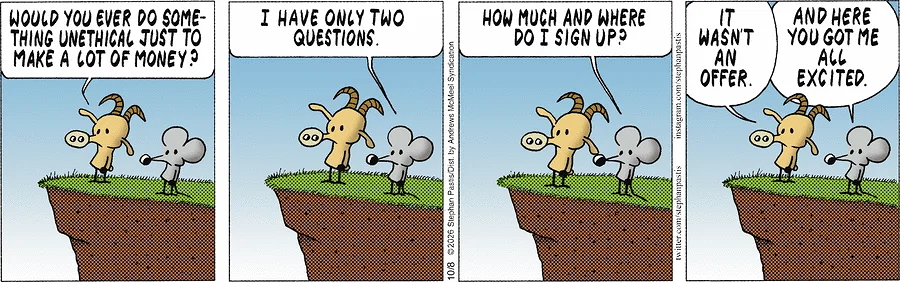

Betty
Click on image for higher resolution.
Do you agree with
- Betty, who wants to try the project, knowing that there might be problems, or
- Bub, who wants to be cautious?
I have to admit, right now with so much uncertainty in the world, I would at least wait for a bit to see what happens.
I’ve been thinking a lot lately about a story by Herodotus, so I asked Claude:
What is the story of Croesus and the Persian Empire?
It answered:
Croesus and the Persian Empire
Croesus was the last king of Lydia (reigned c. 560–547 BC), a wealthy kingdom in western Anatolia (modern-day Turkey). His story is one of the most dramatic cautionary tales of the ancient world.
The Richest Man in the World
Croesus was proverbially wealthy — the phrase “rich as Croesus” still exists today. Lydia was blessed with natural gold deposits, particularly in the river Pactolus, and Croesus is often credited with minting some of the world’s first true coins. His wealth attracted admiration from across the Greek world, and he made lavish dedications to the oracle at Delphi.
The Warning from Solon
According to Herodotus, the Athenian statesman Solon visited Croesus’s court. Croesus, proud of his fortune, asked Solon who the happiest man in the world was — expecting to be named. Solon instead cited obscure, ordinary Greeks who had lived virtuously and died well. He warned Croesus: “Call no man happy until you see the end of his life,” meaning fortune can reverse at any moment. Croesus dismissed this as foolishness.
The Oracle and the Fatal Mistake
When Cyrus the Great of Persia began rapidly expanding his empire, Croesus grew alarmed. He consulted the Oracle at Delphi, asking whether he should attack Persia. The oracle replied that if he crossed the river Halys (the border), “a great empire would be destroyed.” Croesus took this as a green light and invaded.
It was a catastrophic misreading. The empire destroyed was his own.
The Fall of Lydia (547 BC)
Cyrus met Croesus in battle at Thymbra. After an initial inconclusive engagement, Cyrus used a famous tactic — placing camels at the front of his lines, whose smell terrified and scattered the Lydian cavalry. Croesus retreated to his capital, Sardis, which Cyrus besieged and captured within two weeks. The Lydian empire fell, and Croesus was taken prisoner.
Croesus on the Pyre
Herodotus tells perhaps the most memorable part: Cyrus ordered Croesus to be burned alive on a funeral pyre. As the flames rose, Croesus cried out the name of Solon three times. Curious, Cyrus had him pulled from the fire and asked why. Croesus explained Solon’s warning about the fickleness of fortune — a lesson now bitterly understood.
The story goes that Cyrus was so moved by this wisdom (perhaps reflecting on his own mortality and the impermanence of power) that he spared Croesus’s life. Some accounts say Apollo intervened and sent rain to quench the flames. Either way, Croesus survived and reportedly became an advisor to the Persian court.
Legacy
The tale resonated deeply in the ancient world because it illustrated several timeless ideas:
- Hubris and its consequences — overconfidence in wealth and power
- The ambiguity of oracles — divine messages can be true in unexpected ways
- The wheel of fortune — even the mightiest can fall
- Wisdom over wealth — Solon’s insight outlasted Croesus’s gold
For Herodotus, Croesus served as a kind of opening act for his whole Histories — a symbol of the clash between East and West, and a meditation on why great powers fall.
I wonder why I keep thinking of that story now?
April 8, 2026